OpenAI’s $5.5B Bet on AI Infrastructure
– 5 min read
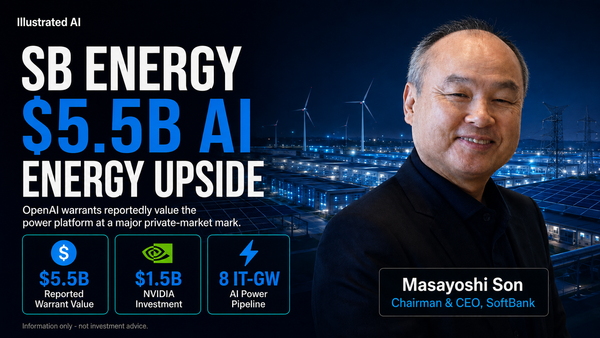
AI may look weightless on a screen, but behind every chatbot response sits very physical machinery demanding land, buildings, chips, cooling systems, and above all, electricity. This hidden reality is reshaping the economics of advanced AI. The most powerful models are no longer limited by clever code or scientific talent—they are increasingly limited by access to real-world infrastructure.
Invest in top private AI companies before IPO, via a Swiss platform:
 SmartProfit Finder AG
Frontier AI is fundamentally different from early software. Training leading models demands massive GPU clusters, enormous data-center campuses, and industrial-scale power supplies. Power generation, transmission, permitting, and construction all take time. The future of AI depends not just on intelligence, but on infrastructure that can support it at scale.
This makes large infrastructure relationships strategically critical. Energy developers, data-center operators, and chip providers are becoming deeply intertwined with leading AI firms. Power is no longer a background utility—it is a strategic resource. The market is shifting from thinking in megawatts to gigawatts, signaling that frontier AI is entering an era where winners may be those who lock in massive physical capacity before scarcity becomes obvious.
For investors, value is being created in previously overlooked places. Companies controlling land, power access, and AI-ready facilities may gain leverage over one of the most important technology waves of the decade. Digital disruption is now being built with concrete, steel, and electricity.
A warrant is an equity-linked instrument that can give its holder the right to acquire shares under specified terms. Its economic value depends on factors including the company's valuation, exercise terms and any applicable vesting or performance conditions. This distinction reveals how strategic AI infrastructure relationships are actually being built: through aligned incentives rather than simple transactions.
When an AI company receives warrants tied to an infrastructure provider, it is not merely buying compute capacity. It is gaining rights connected to that provider's value creation—a far richer and more strategic connection than a normal customer contract. The reported increase in the fair value of the warrants reflects the higher valuation being assigned to SB Energy and highlights the growing economic significance of its strategic relationship with OpenAI.
The logic is compelling: infrastructure providers want committed customers and financial support; AI companies want reliable access and upside participation. The result blends customer status, capital support, and ownership potential into one relationship that strengthens loyalty and reduces the risk of either party abandoning long-term commitments.
For investors, warrants are signal flares showing where future value may concentrate. However, they also demand careful analysis of terms, potential dilution, and valuation assumptions. The plain message is straightforward: infrastructure has become so valuable in AI that companies are using sophisticated financial tools to secure, share, and profit from it.
Frontier AI is ending the illusion of weightless digital growth. The current buildout resembles heavy industry—giant campuses, vast electrical systems, specialist construction, long equipment lead times, and multi-sector coordination. When projects are measured in gigawatts rather than megawatts, the conversation shifts from technology to national-scale industrial planning.
The system breaks down simply: AI needs chips, chips need servers, servers need buildings, buildings need cooling and power, and power needs grid access, generation, and transmission. Every link can become a bottleneck. Companies are no longer just asking how to improve algorithms—they are asking where to find land, source electricity, and coordinate deployments over many years. These are questions of builders, not just coders.
Long-term capacity leases tell an important story: customers are willing to commit far ahead of immediate need to secure future supply—exactly what happens when scarcity is anticipated. For investors, this opens a new lens on value creation. Land pipelines, power procurement, construction milestones, and customer precommitments may prove just as important as the latest model launch.
Industrial projects bring industrial risks—delays, cost overruns, regulatory hurdles, and grid constraints. The opportunity is large precisely because the work is hard. Frontier AI is now scaling through concrete, cables, and substations, meaning the next chapter will be written not only in research labs, but on industrial campuses built to power the digital economy.
In the new AI infrastructure world, traditional roles are blurring. The same parties may simultaneously be customers, strategic partners, investors, and execution enablers. This kind of interlocking network can move faster than conventional market structures because incentives are tightly aligned—capital supports buildout, buildout supports customer commitments, commitments support valuation, and valuation attracts more capital.
Such convergence requires careful thought. Investors must ask: How dependent is the company on one major customer? How much influence do strategic backers hold? Are project economics robust if one partner changes course? Tightly connected ecosystems look strong when everything moves smoothly, but interconnected structures can also transmit pressure quickly when one link weakens.
Well-aligned consortiums of technology companies, infrastructure builders, and capital providers can attempt projects impossible for any single participant alone—securing land faster, financing construction more confidently, and attracting market attention more effectively than fragmented competitors.
What is really being built is not just a campus or a contract—it is a network of mutual dependence designed to accelerate AI's industrialization. Like all powerful machines, it rewards those who understand how the gears fit together.
When an AI infrastructure company approaches a public listing, the story shifts from selective private discussions into broader scrutiny. These businesses occupy fertile middle ground where power, property, compute, and strategic relationships converge—capturing growth from multiple themes simultaneously.
Public investors would focus on key questions: How strong and visible is future demand? How secure is access to power, land, and construction resources? What are the economics once sites are fully operational? How concentrated is the customer base? Valuation in disruptive sectors depends on belief in future scale, requiring the dream to be translated into operating detail.
A listing could establish a benchmark for the entire AI infrastructure sector. If investors award strong valuations, it signals that AI-related physical assets deserve a premium due to scarcity and strategic importance. If the market is cautious, it may reflect execution or concentration concerns. Either way, the listing becomes a referendum on how markets value the industrial backbone of AI.
Beyond valuation, a successful listing provides fresh capital firepower for larger projects and more ambitious expansion. Public markets also bring discipline—quarterly reporting and transparency expose weaknesses that private markets tolerate more easily. Long construction cycles and concentrated partnerships require especially clear communication.
The real significance: when markets start pricing the pipes, wires, land, and power behind AI with the seriousness once reserved for software alone, a new investment era begins. The invisible revolution becomes visible on the balance sheet.